The Bears like to say they aren’t asking Illinois to pay for their stadium, only for roads and other infrastructure plus certainty on property taxes. Critics say that’s a distinction without much difference. One useful way to judge the ask is to compare it with what other NFL teams have recently gotten. Short version: in dollars, the Bears’ request is in the normal range. As a share of the project, it’s on the low end, unless you count the property tax break.
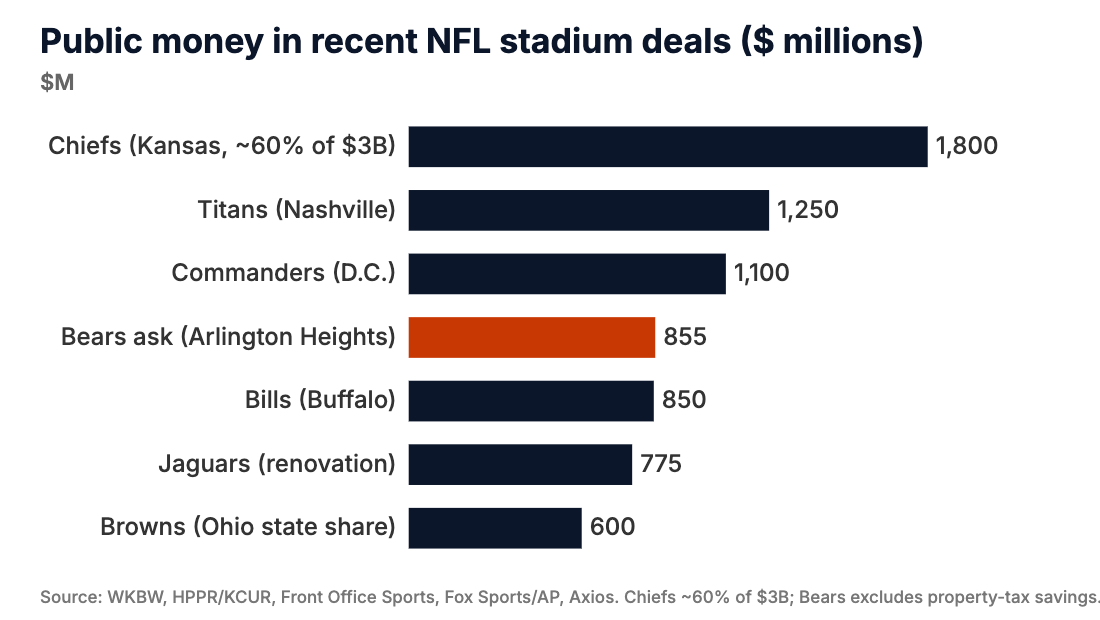
The recent deals
| Team | Project | Public money | Team / private | Status |
|---|---|---|---|---|
| Buffalo Bills | New open-air stadium; cost grew past $2B | $850M ($600M state, $250M Erie County) | Pegula family about $1.35B plus overruns | Opening 2026 |
| Tennessee Titans | Enclosed stadium, about $2.1B | About $1.25B ($500M state, $750M Metro bonds) | About $850M (team, NFL, seat licenses) | Target Feb. 2027 |
| Kansas City Chiefs | $3B dome in Kansas; $4B with development | About 60% via Kansas STAR bonds | About 40% plus $7M/yr rent | Opening 2031 |
| Cleveland Browns | Dome in suburban Brook Park, about $2.6B | $600M from Ohio (blocked in court); Brook Park share still being negotiated | At least 67.5% plus all overruns | Target 2029 |
| Washington Commanders | RFK site, about $3.8B with development | About $1.1B from D.C. | At least $2.7B plus overruns | Approved 2025 |
| Jacksonville Jaguars | Renovation, $1.4B | $775M | Remainder | Target 2028 |
| Chicago Bears (ask) | About $5B dome and district | About $855M infrastructure, plus property tax relief | About $2B toward the stadium | Not approved |
The border war Illinois is trying to avoid
The closest parallel to the Bears’ situation is the Kansas City Chiefs. For two years Missouri and Kansas bid against each other. Missouri’s offers reportedly included state support for up to half the cost. Kansas went bigger: in December 2025 its lawmakers backed a STAR bond deal, a structure where future sales taxes in a special district repay the bonds, covering about 60% of a $3 billion domed stadium. In April 2026 Kansas created a sports authority, and on October 13, 2026 it set the STAR bond district’s boundaries across six cities. The stadium is slated to open in 2031 in Wyandotte County, Kansas.
That’s the scenario Illinois leaders keep pointing to: a neighboring state builds a public-ownership structure, puts real money on the table, and wins. Indiana’s Hammond law follows a similar playbook.
The suburban move: Cleveland
The Browns are the clearest example of a team leaving its downtown for a suburb. They’re moving from the Cleveland lakefront to Brook Park, near the airport. Ohio’s budget set aside $600 million from the state’s unclaimed-funds pool, but a judge blocked that money in March 2026 and the lawsuit is ongoing. The team responded by raising its own commitment to at least two-thirds of the cost and covering all overruns. It broke ground in April 2026 with the public funding still unsettled.
Why percentages can mislead
If you divide the Bears’ roughly $855 million infrastructure ask by a $5 billion project, you get about 17%, one of the lowest public shares among recent deals. But that leaves out the property tax piece. Under the stadium-authority model Illinois is now reportedly considering, the stadium itself would pay no property tax. Neil deMause of Field of Schemes, a longtime subsidy critic, estimated that exemption is worth roughly $53 million a year, or about $900 million in today’s dollars. Add that and the public share looks a lot more like other deals.
Supporters respond that the Bears are paying for the building themselves, that the infrastructure would serve a whole mixed-use district and not just football, and that Arlington Heights stands to gain new tax revenue it doesn’t have today.
What the NFL brings
The league itself isn’t a big funder. Its stadium loan program, known as G-4 and upgraded to G-5 in December 2025, lends teams money repaid from premium-seat revenue. Recent new stadiums have qualified for about $200 million to $250 million. For a $5 billion project, that’s around 5%.
The league’s bigger contribution may be political. Commissioner Roger Goodell toured Arlington Heights and Indiana sites in January 2026, met Illinois leaders in August, and sat down with Gov. Pritzker on October 1. He’s also dangled the prize Chicago has never had: a Super Bowl. The Bears have said they hope to host one as early as 2031 in a fixed-roof stadium. Super Bowl hosts are already set through 2028, and nothing is promised after that.
What economists say
Economists who study stadiums are unusually united. A 2023 review by J.C. Bradbury, Dennis Coates and Brad Humphreys concluded that stadiums produce little to no measurable economic gain for the public, largely because game-day spending mostly shifts from other local entertainment. They also argue that wrapping a stadium in a mixed-use district, or paying for it with hotel taxes, hides the public cost rather than eliminating it.
For Arlington Heights, the regional argument cuts both ways: a stadium would shift spending from Chicago to the suburb, a real gain for the village and mostly a loss for the city.
Sources
- WKBW: Bills vs. Titans — comparing two of the newest stadium deals
- Sportico: NFL approves Bills debt waiver; G-5 loan program
- Bloomberg Law: Titans top Bills for biggest NFL stadium subsidy
- HPPR/KCUR: What will the Chiefs move cost Kansas? (Jan 2026)
- WOWT: Kansas lawmakers approve Chiefs STAR bonds (Dec 22, 2025)
- KCTV5: Kansas sets boundaries for Chiefs STAR bond district (Oct 13, 2026)
- Front Office Sports: Browns boost stadium investment amid funding questions (Mar 2026)
- Front Office Sports: Browns break ground, funding in limbo (May 2026)
- Front Office Sports: Commanders seal stadium deal with $1.1B from D.C.
- Fox Sports/AP: NFL owners approve Jacksonville’s $1.4B stadium of the future
- FOX 32/AP: Goodell expects Titans stadium to host Super Bowl; Chicago awaits its own
- Bradbury, Coates & Humphreys: stadium subsidy policy retrospective (2023, PDF)
- Axios Chicago: Bears infrastructure ask
- Field of Schemes: Illinois adjourns without Bears bill (June 1, 2026)