Every stadium debate comes with dueling numbers. In Arlington Heights there are two main studies, one paid for by the Bears and one commissioned by the village, plus a large body of academic research that is skeptical of stadium economics in general. Here is what each says, and what each leaves out.
The Bears’ study: HR&A Advisors (July 2025)
- About 9,000 jobs statewide, including 5,400 in Arlington Heights.
- About $18 million a year in revenue for the village.
- About $38 million a year for the state and $12 million a year for Cook County, beyond what Soldier Field generates today.
The village’s review: Hunden Strategic Partners (Sept. 28, 2025)
- About $15 million a year for the village, of which roughly $9 million would come from the amusement tax on tickets.
- About $510 million over 40 years.
- Hunden noted that the village’s infrastructure costs were not yet known, so its numbers are revenue, not net gain.
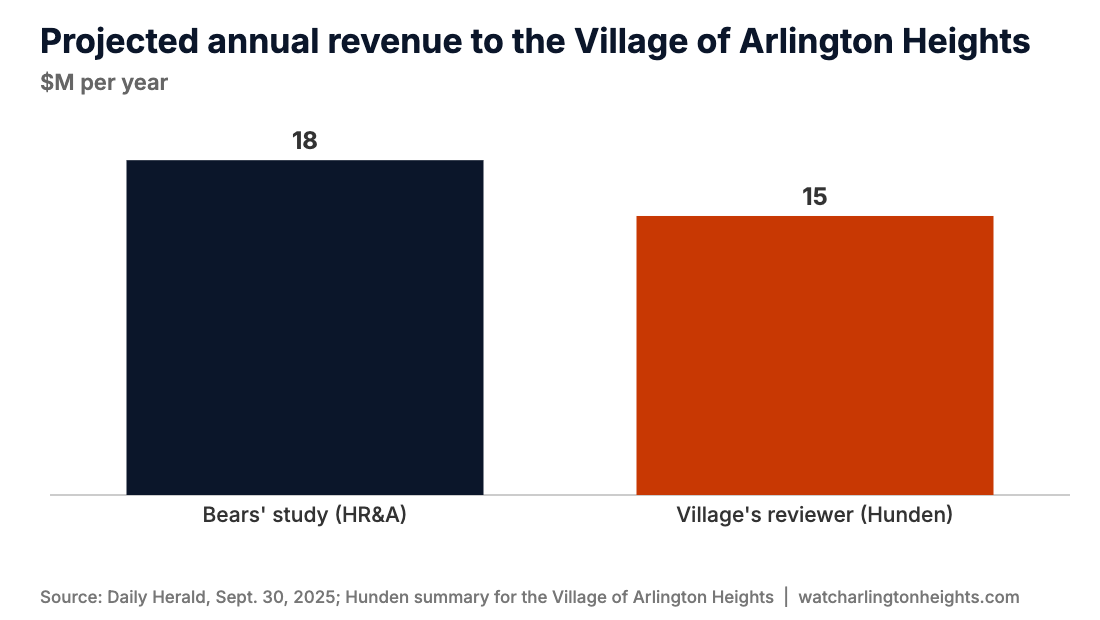
The two studies are fairly close on what the village would collect. Mayor Jim Tinaglia has cited bigger regional figures: about $10.9 billion in one-time economic activity and nearly $2 billion in tax revenue over 40 years.
What the economists say
Academic research on stadiums is unusually one-sided. A 2023 review by economists J.C. Bradbury, Dennis Coates and Brad Humphreys, covering decades of studies, found little to no measurable economic impact from pro sports venues. Their explanation is that most spending at a stadium is money local households would have spent on other entertainment nearby anyway. They also argued that wrapping a stadium in a mixed-use district, or funding it with hotel or “sin” taxes, hides the public cost rather than reducing it.
Other critics have made similar points about this project specifically. Economist E. Frank Stephenson argued that a few thousand hotel stays per game can’t justify a subsidy in the hundreds of millions. The tax-policy groups ITEP and Good Jobs First have criticized the megaprojects framework, citing a governor’s-office estimate that homeowner relief under the bill would be under $2 per homeowner. Field of Schemes argued that economic impact reports like these are not worth much as a guide to public decisions.
Why both sides can be partly right
The disagreement is partly about whose economy you are measuring. For Illinois or the Chicago region as a whole, moving the Bears from Soldier Field to Arlington Heights mostly shifts spending from one place to another. For the Village of Arlington Heights, though, that shift is real new money: amusement taxes, hotel and sales taxes, and a district of homes and businesses on land that now generates about $3.6 million a year in property tax. The same move is mostly a loss for Chicago.
That is why the village’s case is stronger than the regional case. It is also why the open question is less about the village’s revenue and more about what the state and region pay in infrastructure and forgone taxes to make it happen.
What the studies don’t tell us yet
- The village’s share of infrastructure costs, which Hunden flagged as unknown.
- The value of whatever property tax arrangement Springfield passes. Critics have estimated $39 million to $53 million a year depending on the structure.
- Traffic, policing and other service costs on event days.
- How much of the projected spending is new to the region rather than moved from Chicago.
Bottom line
Both consultants project around $15 million to $18 million a year for Arlington Heights, before costs. Economists broadly agree that stadiums don’t grow regional economies much. The fight is over who pays for the parts of the project that aren’t the stadium itself. I’ll update these numbers if either study is revised.
Sources
- Daily Herald: Arlington Heights could collect $15 million a year from Bears stadium, but costs still unknown
- Village of Arlington Heights: Hunden summary of economic impact (Sept. 28, 2025, PDF)
- Field of Schemes: Bears economic impact reports
- Bradbury, Coates & Humphreys (2023): The impact of professional sports franchises and venues on local economies (PDF)
- ITEP: The Bears bill is bad by design
- ABC7: Chicago Teachers Union says megaprojects bill is a bad deal for taxpayers
- Field of Schemes: Illinois legislature adjourns without passing Bears bill
- WTTW: Megaprojects bill would mean $39M annual tax break, Cook County Treasurer’s office says