One piece of the Bears puzzle hasn’t been solved by any proposal so far: the debt from the 2002–03 Soldier Field renovation. Taxpayers are still paying it off, it is tied to Chicago’s hotel tax, and if the Bears leave before it is paid, Chicago is left with an emptier stadium and the same bills. Neither of the spring 2026 bills addressed it, and the deal Crain’s reported in October leaves it unresolved too.
Where the debt came from
The Soldier Field renovation cost about $632 million, of which about $432 million was public money. The Bears and the NFL contributed about $200 million. The project rebuilt the bowl inside the historic colonnades, cut capacity to about 61,500 to 62,500 seats, and cost Soldier Field its National Historic Landmark status in 2006. It is now among the smallest stadiums in the NFL.
The public share was financed with bonds issued by the Illinois Sports Facilities Authority (ISFA), the same state-created body that owns the White Sox ballpark. Those bonds were later refinanced and extended, which is why the bill keeps growing over time even as payments are made.
How much is still owed?
The figures depend on when they were reported, so I’m listing them with dates:
| As reported in | Figure | Source |
|---|---|---|
| March 2023 | About $631M remaining | Chicago Tribune (via Yahoo Sports) |
| March 2024 | $589M owed: $375M principal plus $214M interest | NBC Chicago |
| April 2026 | “Nearly $500M” | Capitol News Illinois |
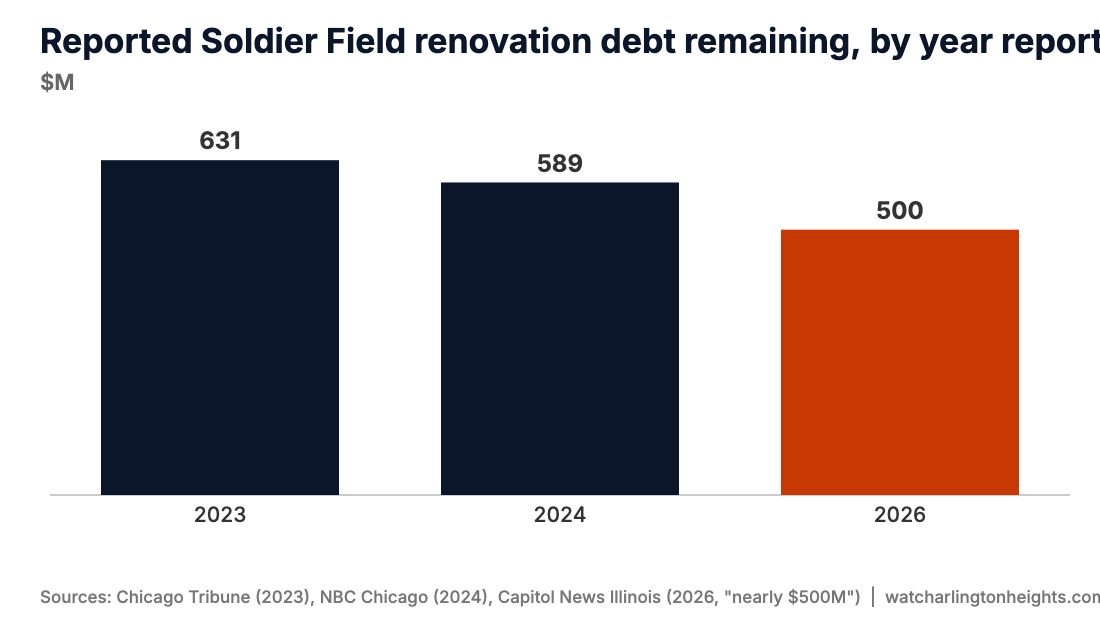
I could not find an exact current balance published by ISFA. The total cost of the renovation financing, once interest is counted, is more than $1 billion.
Who pays it
The bonds are repaid mainly from Chicago’s 2% hotel tax. When hotel tax revenue falls short, the city backfills the gap. In 2022, Chicago covered a $27 million shortfall using part of its share of state income tax money. Annual payments were scheduled to rise from about $55 million toward $90 million, with the bonds paid off in 2032.
The lease and the exit fee
The Bears’ lease at Soldier Field runs through 2033, a year after the bonds are scheduled to be paid off. The team can leave early by paying a termination fee. In 2023 that penalty was reported as $84 million if the team left in 2026; it declines over time. The Bears pay roughly $6.5 million to $7 million a year in rent to the Chicago Park District and keep game-day revenue. I have not been able to confirm the current exit fee schedule.
Why nobody wants to touch it
Chicago’s 2024 lakefront plan would have refinanced and retired the old Soldier Field and White Sox stadium debt as part of a $5.9 billion package. That was part of why state leaders balked at its cost; Gov. JB Pritzker’s office called the plan a non-starter. Since then:
- The House megaprojects bill (HB 910) passed in April 2026 without addressing the debt.
- The Senate stadium-authority bill (HB 958 SA2) in June 2026 did not address it either.
- The October framework reported by Crain’s, citing unnamed sources, reportedly leaves the debt unresolved.
- Chicago officials have said the city would want its own dedicated revenue stream, similar to the hotel tax that funds ISFA, if a new authority structure is created.
Why it matters to Arlington Heights
Soldier Field’s debt is a Chicago problem, but it shapes Springfield politics. Chicago Democrats in the Senate were reluctant to back a tax break for a team leaving the city. Sen. Willie Preston, a Chicago Democrat, voted against the authority bill, saying it would take the Bears right over to Arlington. Any bill that helps Arlington Heights will likely need votes from Chicago lawmakers, and the debt is one of the few bargaining chips the city has.
What to watch
- Whether a veto-session bill includes anything for the Soldier Field debt or for Chicago.
- Any updated balance from ISFA.
- How the Park District plans to use Soldier Field if the Bears leave before 2033.
Sources
- NBC Chicago: Taxpayers still owe $589M on Soldier Field (March 2024)
- Chicago Tribune via Yahoo Sports: Whether the Chicago Bears leave or not (March 2023)
- Capitol News Illinois: Illinois House approves megaprojects bill, but the Bears want changes
- Capitol News Illinois: Lawmakers fail to pass Bears bill despite goal-line push
- Chicago Sun-Times: Bears stadium bill in Springfield (May 31, 2026)
- Chicago Sun-Times: Lakefront stadium plan and Friends of the Parks (May 2024)
- Wikipedia: Soldier Field
- AP via WTOP: Bears say they are moving forward with Northwest Indiana location (June 2026)
- Shaw Local: Chicago Bears choose to advance new stadium project in Indiana
- Patch: Bears near Illinois stadium deal, Arlington Heights favored (Crain’s report)